Unlocking the Power of Regular Tessellations: A Guide to Seamless Pattern Design
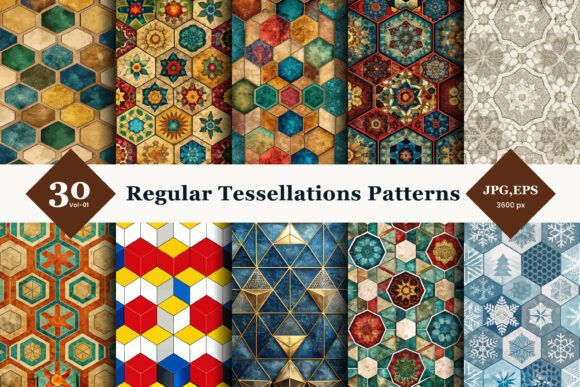
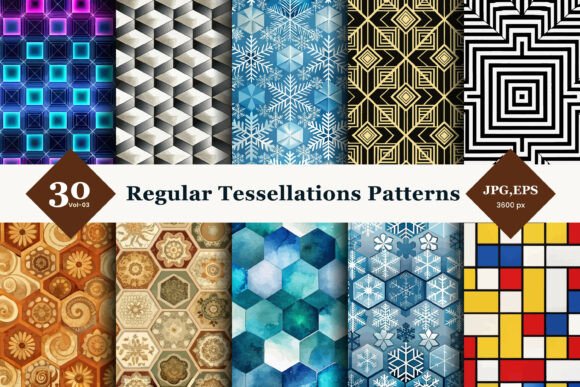
In the world of visual design, few elements are as timeless and versatile as tessellation. Derived from the Latin word tessella, meaning a small square tile, tessellations refer to the tiling of a plane using one or more geometric shapes with no overlaps and no gaps. While this concept has ancient roots in Islamic architecture and M.C. Escher’s famous artworks, it has found a renewed purpose in modern digital and print media through Regular Tessellations Seamless Patterns 03. This collection represents a sophisticated fusion of mathematical precision and artistic flair, offering designers a robust toolkit for creating visually compelling backgrounds and textures.
Whether you are a graphic designer seeking high-quality assets for client projects, a textile artist looking for fresh motifs, or a hobbyist interested in crafting unique stationery, understanding the value of these patterns is essential. This article explores what makes regular tessellations so impactful, how they can elevate your creative work, and why the specific features of the "Pattern 03" collection make them an indispensable resource for modern creators.
The Art and Science of Geometric Harmony
At first glance, a tessellation might seem like simple repetition. However, the beauty of regular tessellations lies in their underlying mathematical structure. A regular tessellation uses only one type of regular polygon—shapes where all sides and angles are equal—to cover a surface completely. The three classic regular polygons that can tessellate a flat plane are triangles, squares, and hexagons.
When designers utilize these shapes, they create a sense of order and rhythm that is inherently pleasing to the human eye. The brain recognizes patterns, and when those patterns are consistent yet complex, they engage our attention without causing visual fatigue. This is particularly important in background design. A busy wallpaper or a textured website background needs to provide depth without distracting from the primary content. Regular tessellations achieve this balance by offering precise geometry and rich visual depth.
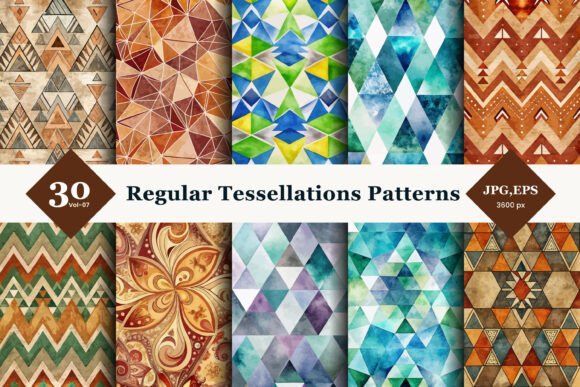
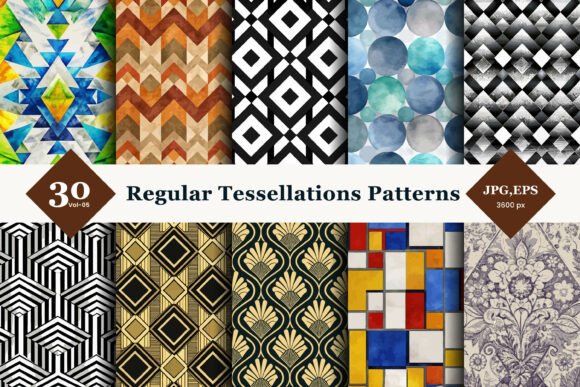
The "Regular Tessellations Seamless Patterns 03" collection expands on these basics by incorporating not just standard polygons, but also artistic mosaic motifs and illusionary cubes. These variations add layers of complexity, allowing the pattern to shift from a simple grid to a dynamic, three-dimensional landscape. For instance, a pattern featuring interlocking cubes can trick the eye into seeing depth on a flat screen, adding a tactile quality to digital designs.
Why Seamless Patterns Are Essential in Modern Design
You might wonder why "seamless" is such a critical keyword in pattern design. In traditional graphic design, if you apply a repeating image to a large area, you often see visible lines or breaks where the images connect. This is known as a "visible seam." A seamless pattern is engineered so that the edges match perfectly, allowing the design to repeat infinitely without any interruption.
This feature is crucial for several reasons:
- Scalability: Seamless patterns can be scaled up to fill a billboard or down to fit a business card without losing integrity or showing awkward cuts.
- Cohesion: They create a unified look across large surfaces, which is vital for branding consistency.
- Efficiency: Designers do not need to manually adjust every iteration of the pattern; once the tile is perfect, the software handles the rest.
By providing files that are inherently seamless, the "Pattern 03" collection ensures that your workflow remains smooth and professional. Whether you are integrating these designs into a corporate identity package or a personal scrapbook project, the assurance of a flawless repeat saves time and enhances the final output.
Practical Applications Across Industries
The versatility of regular tessellations means they are not confined to a single industry. Their application spans across various sectors, each leveraging the unique properties of geometry and repetition differently. Here is how these patterns can be utilized in practical scenarios:
1. Textile and Fashion Design
In the fashion industry, fabric printing relies heavily on seamless patterns. Designers use tessellations to create prints for dresses, scarves, and upholstery. The geometric nature of hexagons and triangles offers a modern, structured aesthetic that contrasts beautifully with flowing fabrics. When printed on silk or cotton, the crisp lines of the vector-based patterns maintain their clarity, ensuring that the garment looks expensive and well-crafted.
2. Digital Backgrounds and UI/UX
For web developers and app designers, background imagery plays a significant role in user experience (UX). A plain white background can feel sterile, while a chaotic image can be overwhelming. Regular tessellations offer a middle ground—they are engaging enough to add character but subtle enough to keep the focus on text and calls-to-action. High-resolution JPGs at 300 DPI ensure that these backgrounds look sharp on high-density Retina displays and mobile screens alike.
3. Packaging and Branding
Product packaging is a prime real estate for brand storytelling. Using a custom tessellation pattern on wrapping paper, boxes, or tags can instantly differentiate a product on the shelf. The "artistic mosaic motifs" mentioned in the collection description allow brands to convey sophistication and attention to detail. Imagine a luxury chocolate box wrapped in a subtle, golden hexagonal pattern—it suggests premium quality before the consumer even opens the package.
4. Education and Creativity
On an educational level, tessellations are powerful tools for teaching geometry and spatial reasoning. Teachers can use these patterns to demonstrate concepts like symmetry, rotation, and translation. For crafters, these patterns serve as templates for quilting, embroidery, and paper cutting, encouraging creativity within a structured framework.
Technical Superiority: JPG vs. EPS
One of the standout features of the "Regular Tessellations Seamless Patterns 03" collection is its dual-format availability. Understanding the difference between these file types is key to maximizing their utility.
High-Resolution JPG Files (300 DPI)
JPEGs are raster images, meaning they are made of pixels. The inclusion of 300 DPI (dots per inch) resolution is critical for print projects. Standard screen resolution is typically 72 DPI, which looks fine on a monitor but appears pixelated and blurry when printed. By providing 300 DPI files, the collection ensures that your designs will look crisp and professional when sent to a printer, whether for large format banners or small business cards.
Customizable EPS Vector Files
EPS (Encapsulated PostScript) files are vector-based. Unlike raster images, vectors are defined by mathematical equations rather than pixels. This allows for unlimited resizing without any loss of quality. You can scale a vector pattern from the size of a postage stamp to the size of a building facade, and the edges will remain perfectly sharp. Furthermore, because these are customizable files, experienced designers can alter colors, line weights, and individual elements to suit specific brand guidelines. This flexibility makes the collection not just a library of assets, but a starting point for original creation.
Common Misconceptions About Geometric Patterns
A common misconception among beginners is that geometric patterns are rigid or boring. People often associate strict geometry with coldness or lack of emotion. However, as seen in the "Pattern 03" collection, geometry can be incredibly expressive. The interplay of light and shadow in cube motifs, or the organic flow of mosaic arrangements, adds warmth and personality to the design. Another assumption is that creating seamless patterns requires advanced coding skills. While programming can generate patterns, dedicated design software allows anyone to manipulate these tiles intuitively, making the barrier to entry much lower than one might think.
Getting Started with Your Project
Integrating these patterns into your workflow is designed to be straightforward. With instant download access, you can begin experimenting immediately. Here is a suggested workflow for getting the most out of the collection:
- Select Your Base: Browse the 30 unique patterns and choose one that aligns with the mood of your project. Do you need something bold and energetic, or subtle and elegant?
- Choose Your Format: If you are printing, start with the 300 DPI JPGs. If you are designing for web or need to edit the colors, open the EPS files in Adobe Illustrator or similar vector software.
- Customize: Use the vector capabilities to adjust hues to match your brand palette. Experiment with opacity levels to make the pattern act as a texture rather than a dominant element.
- Apply and Review: Place the pattern in your layout. Check for seams at the edges of your canvas. Because these are pre-seamless, you should see a continuous flow, but always zoom out to check the overall effect.
Conclusion
Regular tessellations are more than just decorative shapes; they are a fundamental language of design that speaks to our innate appreciation for order and beauty. The "Regular Tessellations Seamless Patterns 03" collection harnesses this power, offering a diverse array of hexagons, cubes, triangles, and mosaic motifs that are ready for immediate use.
By providing both high-resolution raster files and fully customizable vector sources, this resource caters to a wide spectrum of creative needs. It bridges the gap between technical precision and artistic expression, making it an invaluable asset for professionals and enthusiasts alike. Whether you are enhancing a digital portfolio, designing a new line of textiles, or simply exploring the joy of geometric art, these patterns offer a reliable foundation for excellence. Embrace the geometry, explore the possibilities, and let these seamless designs elevate your creative work to new heights.